


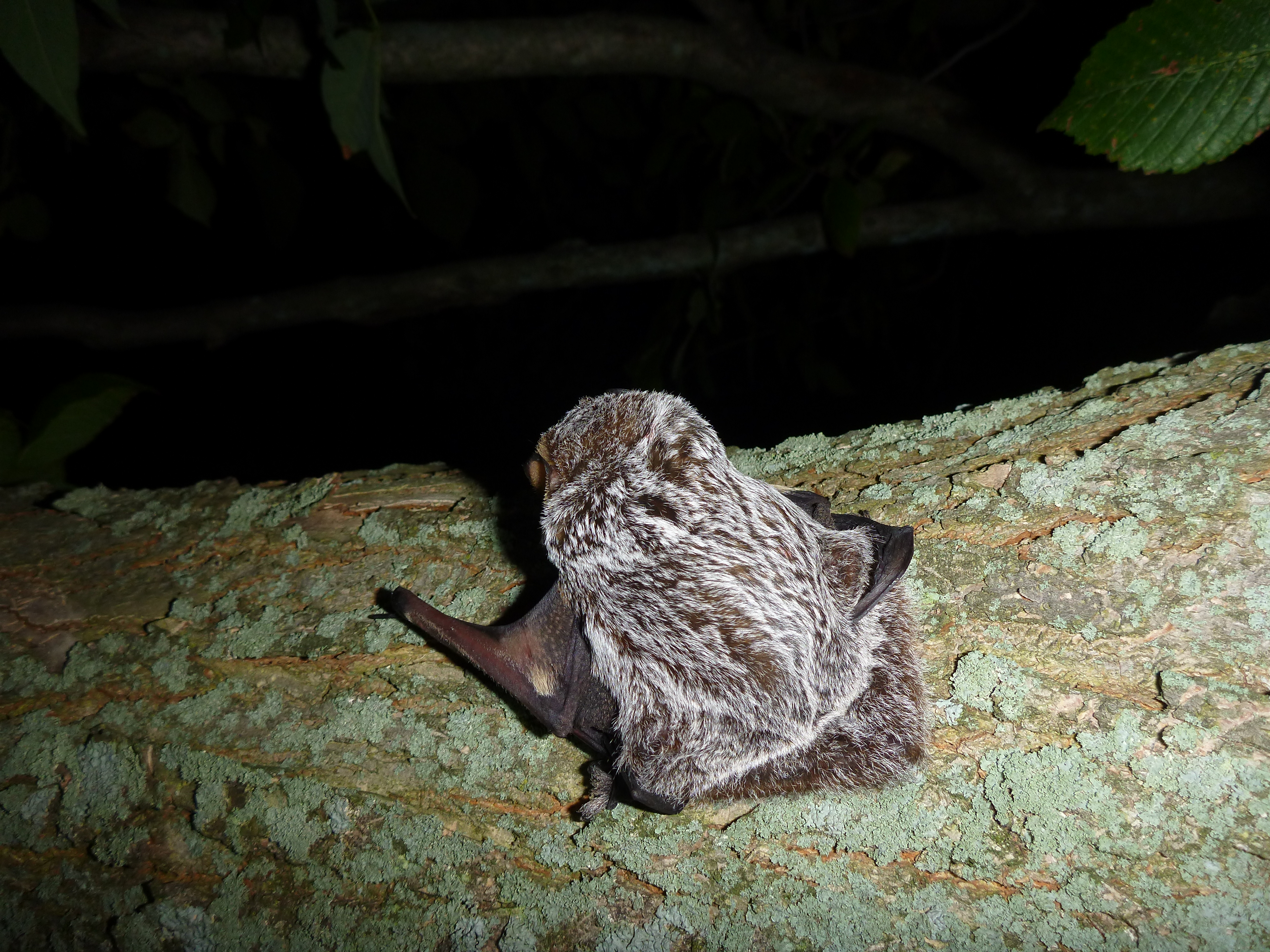
Hoary Bat (Image Courtesy of Larisa Bishop-Boros [CC BY-SA])
Last week, we shone a light on some truly tiny microbats (California Myotis & Yuma Myotis) - ones that are barely the length of your index finger and that weighs about as much as a quarter. But microbats, being the more widespread of the two major suborders, come in many shapes and sizes to fill many different niches in ecosystems around the globe. This week, I would like to focus on two larger bats: still tiny creatures, but much larger than the average microbat.
Widely distributed throughout North America (even south into parts of Colombia and Venezuela!), the big brown bat (Eptesicus fuscus) is big enough to nestle into your open hand. It is most easily recognized by its mid-brown coat, small ears and eyes, and blunt face. It can weigh 15-26 grams (nearly a full ounce) with a wingspan just over 12 inches. They are roughly around 4-5 inches long, a little shorter than an outstretched hand.
Their diet is particularly advantageous for humans; it feasts mainly on beetles, including several major agricultural pests such as cucumber beetles and scarab beetles. While they often hibernate in human structures, they are remarkably resistant to cold temperatures (provided they have sufficient fat stores) and may even hibernate in colder, more exposed areas, even among icicles! Many bat species birth just one pup per year, but the big brown bat commonly births twins! Interestingly, this behavior is limited to the eastern United States. In the west, one pup per birthing season is the norm. After their hibernation is over, they form maternity colonies and give birth in the early Summer. While some species of bat take their young with them when hunting, the big brown bat instead leaves behind their young at their day roosts and locate their offspring when they return by scent.
The hoary bat (Lasiurus cinereus) is also widely distributed across the Americas, existing across the entire continental United States and the majority of Canada, even parts of South America such as Chile and Argentina. The hoary bat is Washington’s biggest bat - Around 5-5.5in long with a 15in wingspan, and weighing about an ounce. It is instantly recognizable by its coat of silver-tipped, hoary fur and relatively large size.
This species often migrates for hibernation: Travelling in groups and spending the winter in the southwestern United States and Central America, before returning to more northern latitudes in spring and summer. They are a loner and territorial species: Their hunting grounds are protected and defended by individuals: if another bat enters the territory, it is chased out. They often roost alone in tree foliage unless they are caring for their young. Pups can be carried during foraging until they are about a week old. It is not uncommon for them to give birth to multiple young; litter sizes range from 1-4 pups, with 2 being the most common.
Interestingly, they are rather dimorphic - females are around 40% larger and both sexes occupy different parts of their range; Males are more common in the uplands while females prefer the west and lowlands. It really is fascinating how diverse bats can really be!